Digidol at LSE

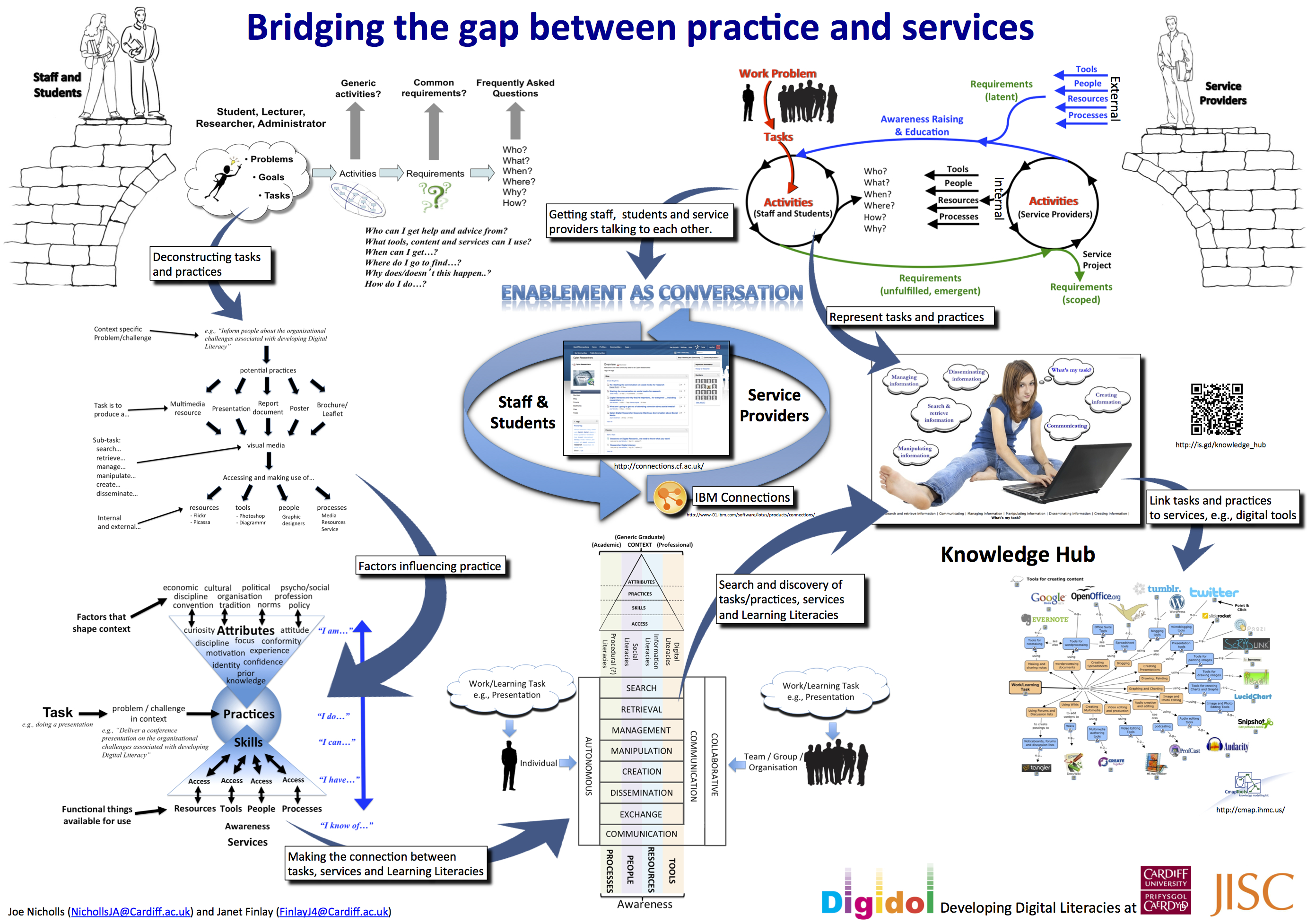
On 6th February we visited the Centre for Learning technology at LSE to present our work as part of their NetworkED seminar series. The talk was live streamed and recorded and summarises both the context of the project at Cardiff and our current work, including how we are using and extending Beetham and Sharpe’s Digital Literacies Development Framework and how this relates to the Knowledge Hub.

The recording is available here: http://clt.lse.ac.uk/events/networkED-seminar-series-08.php

Unfortunately the slides are not synched with the video but hopefully you’ll be able to follow along.

Getting started with Digidol

Today marks two weeks since I started as interim project manager on the Digidol project and I am starting to get a handle on things so I thought it was a good point to reflect on my first impressions of the project, progress to date and where we are heading.

In terms of project management, things couldn’t have been made easier. When Joy went on maternity leave, she left things well organised and documented, making it straightforward to find everything and see what has been happening and who does what. This has made the first fortnight a lot more productive than it might otherwise have been so thanks Joy!

I have joined the project as it enters a new phase. Extensive baselining activities looking at the current extent of digital literacy among academics, students, admin and researchers is complete, providing a picture of a mix of both enthusiasm for and uptake of technologies. Digital literacy has been recognised at an institutional level as an important element and is embedded in core strategies as one of the essential “learning literacies” students and staff need to possess. An initial organisational model to support change management has been proposed. So far so good. The project is on target and there is the essential institutional will to see it succeed.

The new phase focuses on facilitating and supporting that process of change to enable staff and students to make appropriate use of technology to enhance their work practices. Facilitation is happening both through workshops and online resources but therein lies the challenge. Such support – whether provided in the short term by the project – or longer term by services – needs to be contextualised to practice in order to be meaningful and relevant – and digital literacy means being able to identify and exploit the right technology at the right time for the particular job. So traditional generic, technology-focused interventions are not enough.

Our challenge over the second phase of the project is therefore to develop a working and sustainable process that can be taken forward by our service providers to enable staff and student to understand when and how technology would make their work more effective and provide them with the support they need to be able to take it forward. We have started trialling a mixed-media workshop process, which combines short, focused face to face interactions and an online community to explore detail. We are also developing a resource bank, which can be accessed via multiple views to help to surface the possibilities offered by technology for different practices and tasks.

Attempting this for the whole institution and all the possible practice and technology combinations is not feasible so we are concentrating on illustrative exemplars: working with a handful of different disciplinary areas and focusing on a number of representative task areas (such as presentations, meetings and assessment). These will allow us to demonstrate proof of concept and evaluate our model and process.

All this is happening in the context of institutional change so we are mindful that we need to keep one eye on that and how it may change things for us. But all the signs are that the new leadership team will be supportive of our aims.

So an exciting time to join the project and I am looking forward to working with Joe and the team on the next phase.

From strategy to action

We’re coming towards the end of what has been an interesting and challenging phase of the project. From the outset we were acutely aware of the need to win over hearts as well as the minds of those in the University who are best placed to catalyse and promote the development of digital literacy. With this aim we focused our efforts on engaging and meeting with key individuals and groups across the University to identify how we could embed the development of digital literacy into relevant processes and mechanisms. Progress to date has been very encouraging indeed, with a number of strategies, action plans and initiatives now incorporating digital literacy as an integral component. This success will ensure that digital literacy remains in forefront of people’s minds and continues to be an agenda item for some time to come.

We took our initial lead from the University’s Education Strategy, which was invaluable in highlighting digital literacy in the broader context of Learning Literacies. This provided us with the impetus to be able to ask questions of the other University strategies as to how they could engage with this as a driver. We have had extremely positive and fruitful collaborations in such areas as Careers and Employability with the opportunity to feed into their action plan, with the Equality and Diversity group contributing to the Strategic Equality Plan, also close involvement with the development of the University’s Social Media Strategy and the Information Services Digital and Information Literacy Strategy, which was recently fully endorsed by its Board. Work now continues with these various groups to identify from a practical standpoint how Digital Literacy can best be realised in the short to medium term.

This is now leading into more grassroots and hands-on engagement with teaching staff to help them detail appropriate learning opportunities. Examples of this are our collaborations with academics responsible for planning and developing the new C21 Medical Curriculum to specify how both Information Literacies and Digital Literacies can be integrated in an evolutionary way throughout the 5 year course. We are also working with people leading the Cardiff Award scheme to specify content and activities for undergraduates to develop their digital literacy with a view to future employability. And workshops are planned with front-facing staff in Library and IT Services to explore how their own digital and information literacy might be developed and also how they in turn might better enable its development in others.

So, looking back over the first year of the project, much has been achieved in terms of raising people’s awareness about the significance of developing Digital Literacy and making the conversation happen. This has proved invaluable in helping to clarify where and how the project can best contribute to facilitate practice at the ‘coal-face’. This nicely leads us into the next phase of the project which is all about developing and gathering resources and running workshops to give staff and students an opportunity explore what developing their digital literacy actually entails when doing their work and learning.

The work of Project Digidol discussed in ‘JISC on Air’ and the Guardian HE Network

Listen to JISC on Air – Digital Literacy – Delivering the agenda within colleges and universities.

Available at http://jisconair.jiscinvolve.org/wp/2012/04/24/deliveringdigital-literacy/

The sixth episode of the JISC online radio programme, JISC On Air, explores how universities and colleges can help teaching staff, researchers, support and administrative staff to develop their digital literacies.

The show highlights how Cardiff University and other colleges and universities are developing holistic approaches and strategies for supporting the development of these skills and capabilities.

In connection with the Digidol Project, a number of staff and students were interviewed by Kim Catcheside explaining how the project is establishing an institution-wide approach for contextualising and embedding digital literacy into the development of academic staff, students, research students and administrative, managerial and support staff.

Also, Dr Andrew Eynon discusses the Personal Actualisation and Development through Digital Literacies in Education project at Coleg Llandrillo, which aims to create a digitally literate, skilled and confident workforce and student body across all the FE institutions in North Wales (Coleg Harlech, Coleg Menai, Coleg Llandrillo, Deeside College and Yale College Wrexham).

Helen Beetham, synthesis consultant for the JISC Developing Digital Literacies programme, reveals valuable insights into the emerging issues from the programme, and Alison Mitchell, Deputy Director of Vitae, speaks about the importance of digital literacies for researchers.

For further information on JISC’s work in this area visit: http://www.jisc.ac.uk/developingdigitalliteracies

In part two of the show will be looking at how digital literacy underpins the academic success and employability of students.

The work of the Digidol project is also mentioned in an article on the Guardian Higher Education Network site on Digital technologies and the tensions between research and teaching, where Janet Peters (University Librarian and Senior Assistant Director INSRV) is quoted highlighting the potential benefits of developing Digital Literacy of staff and students in the university.

Out and about…spreading the word about Digital Literacy

We’ve been traveling the last few months spreading the word about Digital Literacy and the Digidol project. Here are a few of the presentations we’ve recently given:

What does social media mean for IT Services?
UCISA – Universities and Colleges Information Systems Association
Using Social Media to Communicate , 18th January 2012, Austin Court, Birmingham.

“Project Digidol: developing digital literacy
ALDinHE – Association for Learning Development in Higher Education
9th ALDinHE Conference: Learning Development in a digital age: emerging literacies and learning spaces, 2th-4th April 2012, University of Leeds.

“Digidol: Developing Digital Literacies
LILAC – Librarians’ Information Literacy Annual Conference

11th-13th April 2012, Glasgow Caledonian University

Developing Digital Literacy through social media: trainer and trainee perspectives
UCISA – Universities and Colleges Information Systems Association
Using Social Media for Training ,18th April 2012, University of Salford.

Baselining researcher Digital Literacy

We would like to say a huge thank you to all the researchers who gave up their time to take part in yesterday’s workshop exploring digital literacy. We are using the valuable information gathered to establish a baseline of attitudes and practices amongst researchers to digital technology. Representatives ranged from postgraduate students through to early stage researchers, mid-career and senior research staff.  This varied group provided us with a broad range of views and illuminating discussion on the value and application of technology for research work. Unsurprisingly, there was an extremely diverse range of practices described, with some researchers making extensive use of a wide variety of digital technologies whilst others preferred a traditional approach, working with pen, paper and post-its to meet their particular needs.

Concern was expressed that an overly strong emphasis on technology driven (rather than task driven) methods may promote ways of working that aren’t necessarily the most effective or productive. Researchers are acutely conscious of the time and effort required not only to find out about what technologies are available but also change the way they work. A clear message was that researchers need to be provided appropriate and timely information to help them make a considered choice about the relative value of comparative technology for changing their practice; it must be fit for purpose and demonstrably add value. This highlights a significant challenge for the university to identify ways of raising awareness and understanding of technology enabled opportunities amongst researchers and how to target and tailor education and support. Further information and analysis of this workshop along with findings from an online survey will be available early April as the project’s second baseline report.